Earthquake in the Philippines, June 8th 2026. A soft story story.
Updated: Jul 3

The 7.8 Mw earthquake just south of the Philippines island of Mindanao was not exactly unexpected. The region is tectonically active and has seen many historic large earthquakes. An earthquake with magnitude Mw 7.8 is not huge and doesn't qualify for the terminology in the science to be described as a Great earthquake. But it's alrge enough to cause a lot of destruction and death. In the the map below, the recent earthquake is shown with a yellow star embedded in a background of hundreds of historic eartquakes identified by circles of different size and hue indicating their magnitude and depth. The Map is from the USGS.

At least 60 people died and more than 200 injured. That is, in fact, not an extremely large number of fatalities for an earthquake of that magnitude in a densely populated region. The population dnsity in the region is over 370 people per square kilometer, more than six times the world average of 61. In a newer post on the earthquake doublet in Veneuela where magnitudes were smaler (7.2 and 7.5Mw) the number of deaths is expected to be far more than 2,000.
In places the earthquake caused coastal regions to be uplifted and expose corals. Uplift of more than 6 feet was observed according to the Guardian, usually a reliable source. Uplift is quite common in association with earthquakes of this type which result from two tectonic plates ramimg into one another. One plate pushes its way beneath the other and may cause the upper plate to rise in respose.
What sort of damage occurred?
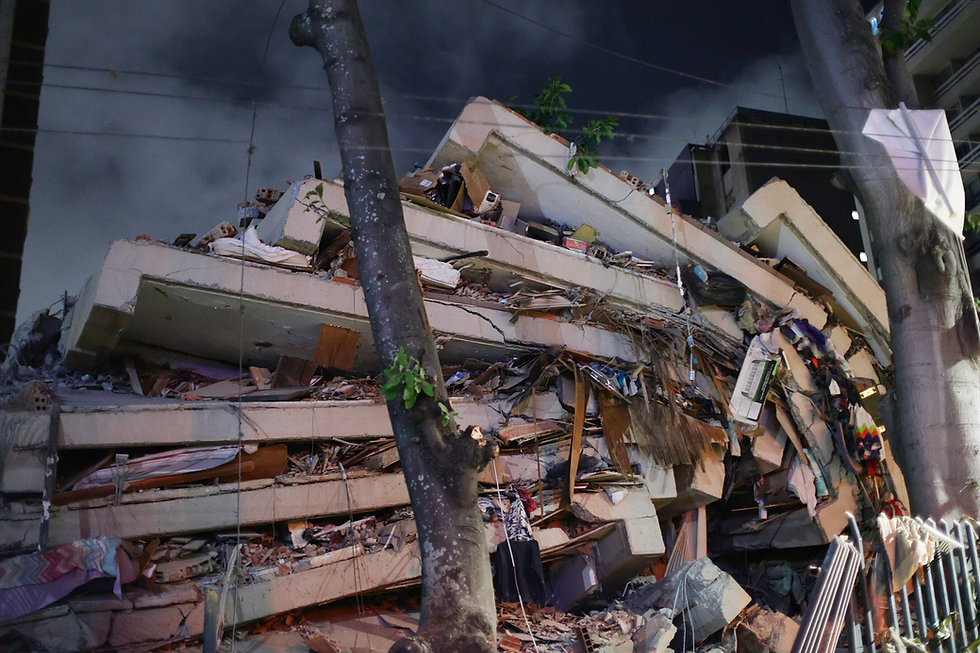
Many of the images of destruction like that above show the same features. Technically this is known as "soft story collapse" and occures when a building structure is supported by relatively thin columns that create open space that is often used for parking or businesses. There are often residences above. The graphic below shows the idea.

It shows a two story residential structure atop weak columns that have failed during earthquake shaking. Although it is a sketch it quite accuratly describes the cause of the damage seen in the image of the image at the top of this article. And below is an image of cars squashed beneath a collapsed buiding in California following the Northridge earthquake. So, the soft story collapse is not unique to developing countries. It's not hard to imagine that residents in the builings above, which often appear titled but greatly damaged might have survived, albeit very shaken up.
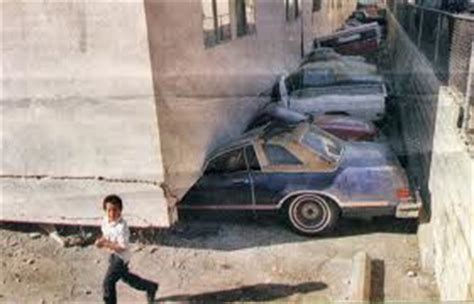
Buildings can be retrofit to reduce the possibility of soft story collapse. It basically involves strengthening the lower, soft story which might include replacing the columns that support the upper stories with much stronger structures, and filling in some open spaces.

While these measures are entirely plausible and require no sophisticated engineering skills they may not be affordable in many developing country settings. Most important is not to permit construction of this type of building.


Comments