Devastating earthquake doublet in Venezuela June 2026.
Updated: Jul 15
The death toll from the recent earthquake doublet in Venezuela remains to be seen. As so often happens, early estimates were very low., just 100 or so. As of today, July 2nd 2026, the count has exceeded 2,000 and doesn't look like setting out any time soon. Speculation has it that it could reach 10,000. That would not be surprising. Estimates in July are over 8,000.
Obtaining an accurate death toll is a difficult undertaking, more difficult than you might think. At first, people can only see what's going on around them, but not anywhere further away. People are intent on helping family and neighbors and not reporting in to some central authority talling up the figures. They might not even know who to tell. So early numbers are invariably low. Most people rescued in the first hours after an earthquake are saved by their neighbors, not emergency workers. Then, with time, it starts to be known that many people are missing and more and more bodies are located. Figures can take weeks or months to settle down. It is not uncommon for people to remain missing long after an earthquake has happened. Are they dead or have they left the area? Surely if they had left they would call in and tell someone that they are alright. According to the ABC, something like 50,000 people are unaccounted for. Many of them are likely to be fatalities. Over 11,000 have been reported injured. That number is probably more accurate as it comes from hospital records, the Red Cross and other aid agencies.
The numbers seem unusually large. The dual earthquakes at 7.2 and 7.5 Mw are far from small, but they don't qualify as Great earthquakes in the parlance of seismology science. The high death toll looks to be related to the style of construction. So many images of building damage look like the one below..
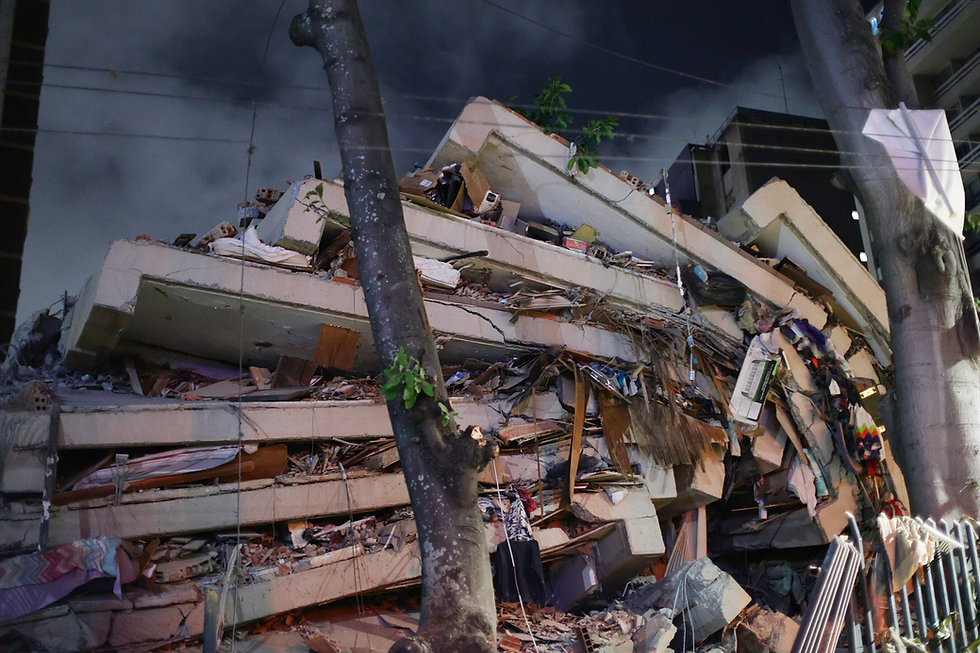
This is known as progressive pancake collapse. You see seven concrete slabs piled on top of one another. The lower three are nearly horizontal, the upper ones are tilted bit. Each was a floor of a building before the collapse. The distance between floors was probably 10 to 12 feet and has been reduced to almost nothing, just a crush of rubble between the slabs. Chances of survival of anyone in the building is tiny. Satellite data puts the number of collapsed or damaged buildings at around 60,000. Assuming there were at least some occupants in every one of those buildings it's easy to see how a massive death toll is possible.
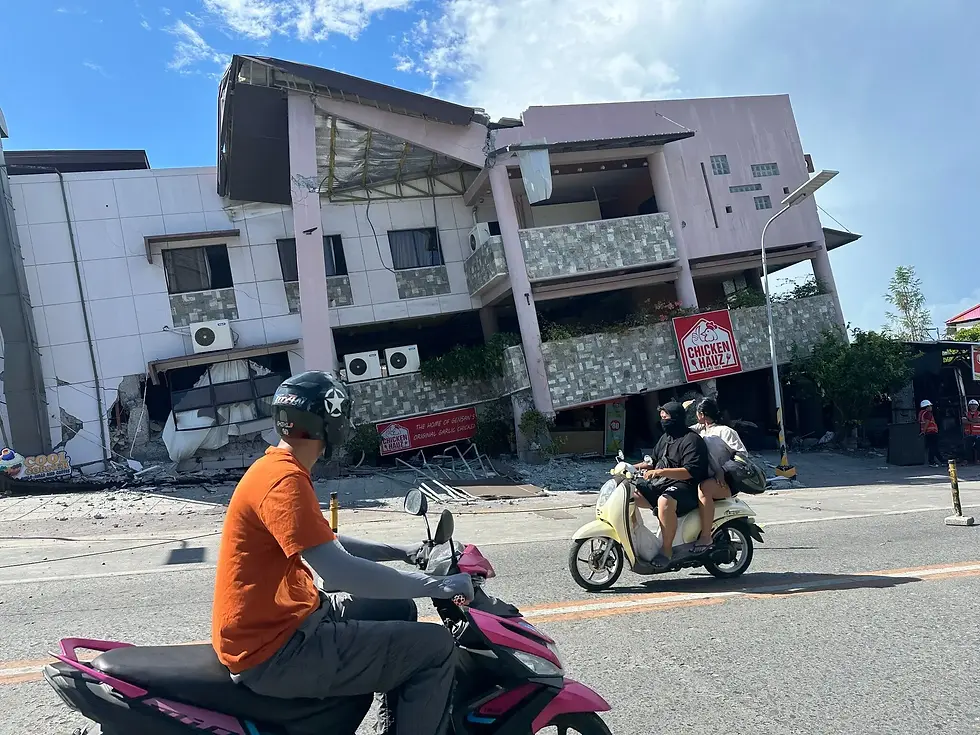
In a previous blog discussing the earthquake in the Philippines in June 2026, I described the phenomenon of soft story collapse. This happens when the lowermost story of a building is weak and buckles when shaken by an earthquake. The upper floors often tilt but stay more or less intact, especially if there are only two stories or so above as is common. Here, in Venezuela, all the floors of many buildings were soft and came down one upon the other. In video images you often see the lowest floor give way first and the rest progressively collapse almost vertically downward. The buildings were barely supporting their own weight before the earthquake and failed catastrophically when shaken.
An unusual doublet
There were two earthquakes. The first with magnitude 7.2 Mw and the second with magnitude 7.5 Mw. The way earthquake magnitudes are scaled the second is actually much larger than the first. The first was also deeper than the second, around 20km compared to about 10km. For the same magnitude shallower earthquakes cause greater ground shaking and more destruction. It's essentially impossible to say which of the two earthquakes caused the greatest destruction, more than likley it was the second because of the greater magnitude and shallower depth. It's possible that the first earthquake weakened buildings making them more likely to collapse when shaken by the second.
The two earthquakes are not a mainshock and aftershock sequence. Were that the case the second shock would have been smaller than the first and not as close in time. Aftershocks have a known behavior. After the mainshock, the aftershocks become progressively smaller and spaced further apart in time. The behavior is known as Omori's Law, proposed by Fusakichi Omori in 1894. The functional form is hyperbolic.
More correctly the 7.2 Mw earthquake should be considered a foreshock, a shock that precedes a mainshock. No equivalent to Omari's law has been discovered for foreshocks, although seismologists have been studying the phenominon for decades. Sometimes a sequence of earthquakes is recognized to be a foreshock sequence, but only after the mainshock has occurred. This happened when seismologists studied the records following the L'Aquilla earthquake in Italy in 2009. There is great hope that AI will hold the answer since it can analyze vast amounts of data and discern patterns that might hold clues to the recognition of foreshock sequences ex anti. If so that could provide critical warning for affected populations. If that can be achieved it would be a huge benefit to earthquake prediction and warnings.
In my next blog post I describe heterogeneous nature of builing damage in Venezuela and provide some explanations.


Comments