Deep Sea Mining: the good, the bad and the ugly.
Updated: Aug 29
Surprising to many, including myself at one time although I am a marine geophysicist, the deep seafloor in many parts of the world's oceans is strewn with fist-sized nodules chock full of what have come to be called critical metals (or minerals). They are known as polymetal nodules, or maganese nodules. A typical example is shown below. They contain manganese and a lot more metals including copper, cobalt, nickel, zinc, silver, gold and Rare Earth elements. That’s what’s meant by pollymetallic--many metals. They form over millions of years by the precipitation of metals from sea water around an object like a shark tooth. The concentration of these metals in sea water is minuscule which is why the nodules take such a long time to form. They are by no means renewable.

These metals are essential in all manner of electronics, and particulrly batteries, that are essential for the transition to non-carbon fuels and therefore important in reducing Greenhouse gas emission. Everyone's smart phone and laptop contains these metals. But they also see use in military weaponry. If they could be raised from the seafloor at zero cost and zero environmental damage they would be of enormous value and productive use. That you could think of as a public "good".
Presently these metals are mined on land in many parts of the world, often under criminally exploitive conditions and significant environmental damage. But all mining causes envirnmental damage. Is there something special about deep sea mining?
When mining occurs on land we can easily see the consequences. Four thousand meters (three miles) beneath the ocean surface where nodules are found it's not so easy to see. Most observations have been made with unmanned vehicles. Deep sea mining (DSM) doesn't involve creating an enormous hole in the ground. Nodules are on the surface of the deep ocean floor and mining involves scooping them up. No drilling. No excavations. The scooping is done with something like a gigantic vacuum cleaner. It mows the seafloor in strips sucking up nodules which are delivered to a surface ship through an umbilical tube..

It is a messy process as is almost all forms of mining. As the massive vacuum cleaner hoovers up nodules it sucks up everything else on or near the seafloor, and some of the mud layer beneath, and leaves an immense plume of turbulent mud in the deep ocean in their wake that could disperse over great distances, carried by currents, and take many years to settle. The machine depicted here is a visualization. Many machines of this type have been built and tested. One was even stranded on the seafloor when its tether broke loose. There seems little doubt that they will be used. The technology isn't exactly new. They are certainly "ugly" machines. The question becomes one about whether this mining can be conducted with minimum damage to deep sea ecosystems and whether a regulatory regime can be put in place to manage the mining in what could be thought of as the world's largest Commons. But what is down there that could be harmed?
Even the very deep oceans are not barron of life. There are exotic life forms of a type not seen in shallower regions of the ocean. The one below, (Relicanthus daphneae) was found at 4200 meters below the sea surface in the Pacific Ocean and was unknown to science until DSM surveys were conducted. The nodules can be seen here as well but they are not as densely strewn over the seafloor as in the first image. And that's an important thing to know--they dont blanket the seafloor equally everywhere and there are sure to be places where they don't exist at all or in such small numbers that they would not be exonomic to mine. There are probably scores of lifeforms in the deep oceans in areas planned for mining. Many still to be discovered, marine scientists suggest. And they are probably right; only a tiny fraction of the deep sea has been examined.
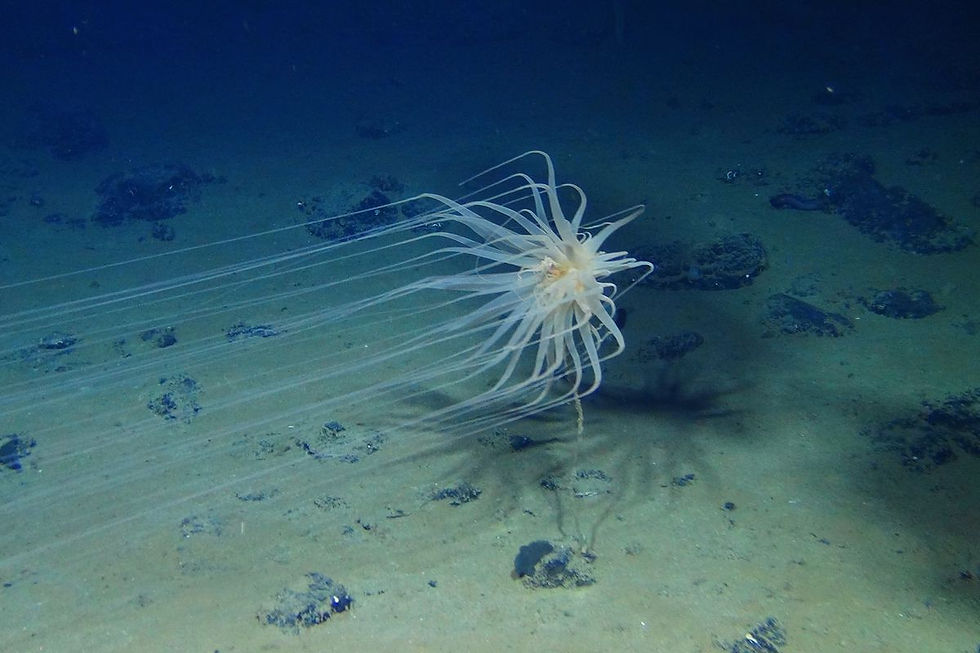
It seems unquestionable that mining using machines like the one shown above will do harm to these creatures. How could it not? As well as being quite exotic in appearence they are frail. Life forms in the frigid, pitch black of the deep sea reproduce very slowly. Meaning that if they are disturbed or reduced in number it would take a very long time for them to recover. Plausibly they may never recover. They are not like pidgeons on the sidewalk that re-congregate immediately after we walk through a group pecking at specs of food.
Harm comes in two forms. One is the direct harm to individual creatures that are sucked into the ugly machines. In addition, the mud plume kicked up by the mining process may take many years to settle and potentially smother life forms that survived the ordeal of the mining. A second mud plume results from discharing the unwanted mud from the surface ship. All that we want are the nodules themselves, but the hoovering operations bring tons of mud to the surface ship as well. The nodules are separated and the mud is returned to the ocean at mid water depths, the affect of which is largely unknown, but could hardly be benign. The NY Times published a very good article with its usually great graphics describing the issues. Greenpeace and many other environmental groups are deeply opposed to DSM as you might guess.
However, it could be argued, that these creatures exist in many parts of the deep ocean where no nodules are found, and where they will not be distured by mining. They do not rely on nodules for their wellbeing. There would seem to be little chance that DSM will cause the extiction of these creatures. Perhaps locally, but not the entire species.
We accept bottom trawling for fish that we eat in much shallower environments so we can have cod, squid, shrimp, rockfish and other bottom dwelers. Trawling cannot selectively bring up only the fish we want to eat but includes any other fish species collectively referred to as by-catch. We accept it. Trawling hasn't led to the extinction of any fish species as far as we know because, unlike deep sea species, most can recover quite quickly.
It's a choice.
On the one hand we benefit from the metals recovered from the seabed. Not only us in the present but people in the future. They could make a meaningful contribution to the future human wellbeing and the wellbeing of other species that inhabit the Earth's surface by reducing Greenhouse gas emissions through the development of renewable energy systems, batteries in particular. That is the good of DSM.
The bad is the real possibility that very non-human special, unique species could be harmed irrecoverably. I am not of the opinion that these creatures are part of a complex food web that leads all the way up to human consumption. Our survival doesn't depend on these creatures. But that's no reason to cause them harm. Their survival may depend on us. Our survival doesn't depend on them.
In Genesis 1.26 we are told that God gave "man" dominion over the animals. But what does "dominion" mean? It doesn't mean the right to wrecklesly exploit all species other than our own for our own good. It might mean stewardship, that we have an obligation to protect. So, we shouldn't willfully harm deep sea life forms even if it is to our benefit.
The machines are the ugly part of the story.
So, how does it balance out? Does the good for our species outweigh the bad for other species? How can we know?
This is not a question that can be answered by science or economics alone, nor in combination. It is a question of morals. Are species like Relicanthus daphneae of equal moral importance than our own species?
I am completing a book titled The Unbearable Choices of Climate Change that explores a range of very difficult choices, like that of deep sea mining, we will have to make to assure our future.
Workshop on DSM, May 2026
Last May we (Scott Barrett and I, with a sustainable development PhD student Sean Reese) held a workshop over a day and a half at Columbia to discuss the many dimensions of the DSM issue. It was titled Risks, Rewards, Regimes and particularly focused on the regulatory regime which is presently in tatters, encouraging President Trump to flaunt all international norms and promote DSM.

We are presently preparing a summary of the workshop for puiblication, hopefully this summer. I will post it here when it is available.

Comments