Deep Sea Mining: Good or Bad?
- jcm767
- 7 hours ago
- 4 min read
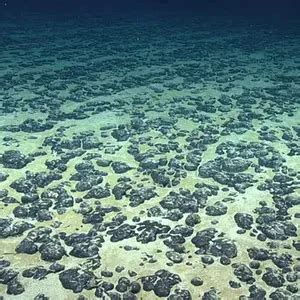
We mine everything, everywhere. Why not mine the deep seafloor? The image below tells what it might look like.

It's not real. It's imagined, but probably fairly accurate. A very large machine is lowered to the sea floor from a surface ship connected by an umbilical tether that can be seen in the image. The machine is guided from a surface ship. It lierally plows the seafloor sucking up polymetalic nodules that are sent to the surface ship where they are sorted and brought to shore, usualy .by a different ship.
What are nodules? Why should we care about them?
What’s on the seabed to be mined are manganese nodules, or polymetallic nodules. They form by one of the slowest natural processes known, but not fully understood. Metals are accreted by precipitation from seawater around objects like sharks teeth that have drifted down from near surface waters to abyssal depths. The concentration of these metals in seawater is miniscule so the process takes a vast amount of time. Nodules can take more than 10 million years to form (the record might be held by one dated at 14.3 Ma). These potato-sized (that’s always the analogy) objects lying on the seafloor are chocked full of precious minerals, manganese and a lot more including copper, cobalt, nickel, zinc, silver, gold and Rare Earth elements. That’s what’s meant by pollymetallic. Those metals are crucial to a wide range of green technologies including batteries for EVs, and are used in wind turbines as well as not-so-green technologies like laptops and smartphones, conventional autos, satellites and even military equipment.

Nodules do not occur everywhere on the seafloor, but are sufficently common that mining might be quite profitable, more so than mining the metals on land. They occur in very deep ocean waters of 4000 meters or more. In some regions they carpet the seafloor, in others they are more sparcely distributed.
Deep sea mining is a dirty business as is almost all forms of mining. Nothing much would be noticeable at the sea surface, but as the massive vacuum cleaner hoovers up nodules it sucks up everything else on or near the seafloor, and some of the mud layer beneath, and leaves an immense plume of turbulent mud in the deep ocean in their wake that could disperse over great distances, carried by currents and take years to settle. What that means for life down there no one really knows but there is concern that it could create great harm to living creatures. Apart from sucking up exotic life forms the mud plume could possibly smother other life forms as the mud settles. A second mud plume is also created from the surface ship when the nodules are separated from other material that is sucked up at the same time. Only the nodules are valuable so the muddy slurry is injected back into the ocean at mid level depths. That too could disrupt ocean life. Some have even suggested that the sound produced by mining equipment could disrupt ocean mammals like whales that use sound to communicate.
And there is no doubt that there are living creatures in the frigid, lightless depths. One is shown below. Its name is Relicanthus, and is seen here swimming (if that's the right word) over a fairly sparce field of nodules. It was unknown to science until surveys were conducted for deep sea mining. In the image of a more dense nodule field above there are two creatures attached to the seafloor. Or perhaps they are attached to a nodule, it's hard to tell. Every marine biologist will tell you there are likley to be many more species yet to be discovered, because the deepest regions of the oceans have not been surveyed at all systematicall,y and in some places, not surveyed at all. We really don't know what's down there.

There can be little doubt that deep sea mining would, at the very least, disturb these creatures. It might not drive them to extinction, but it is certain to do harm to them. These life forms don't depend on nodules in the sense that the nodules are not a life support system nutrients for them. Some attach themselves to nodules and would be consumed by the machines that suck up the nodules. Because it is very cold at the ocean depth where these creatures live, just a few degrees above freezing, their reproduction rates are very slow. There is no light so they don't photosynthesize which is a relatively fast process. So, even if their populations are not completely decimated they will take a very long time to recover.
Do we have the right?
Greenpeace says no. So do many other environmental groups. It can sound a bit odd sometimes--we don't know exactly what is down there, so we need to protect it, whatever it is.
It's a choice, a terrible choice. On the one hand, having access to these resources could enable the development of technologies that could help secure the fate of the human species against the threat of climate change. But, I have to think that those who are bent on mining the sea floor have little interest in the fate of anyone but themselves. It's a way to make money, that's all.
Or, should we privilege these exotic oither-worldly species above our own. If you have a faith you could say that they are God's creatures and we have no right to interfere with them. Even if doing so benefits our species, perhaps God's greatest creation, greater even than Relicanthus.
How do we chose ?

Comments